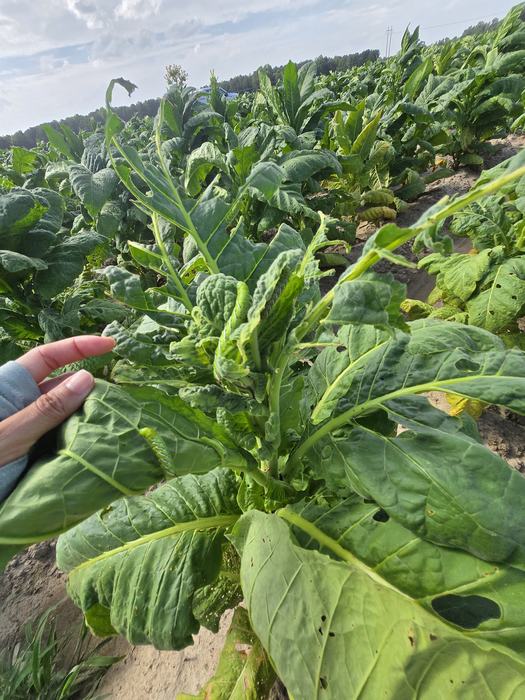
Hornworm pressure has been high in some North Carolina tobacco fields during the 2026 season. Some growers have reported spraying multiple times this season with limited apparent control. These reports have raised questions about possible insecticide resistance. Although resistance should not be ruled out without further evaluation, reduced control during a single season is not enough to confirm it. Resistance is generally suspected when a product consistently fails across multiple seasons despite being applied at the labeled rate, at the appropriate larval stage, and with adequate coverage. This year’s control concerns may reflect a combination of unusually early and high infestations, frequent heavy rainfall, fewer visibly parasitized hornworms, applications targeting large larvae, and challenges in thoroughly covering plants' canopy during insecticide sprays at advanced stages of the crop.
Additional Notes on Hornworm Management
Application Coverage and Timing Matter
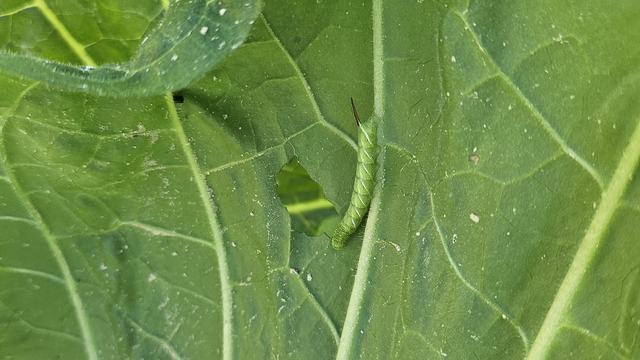
Hornworms are frequently found on the undersides of leaves within the upper two-thirds of the plant. Achieving good canopy penetration can therefore improve insecticide performance, particularly for products that depend on direct contact. Consider the following:
- Spray volumes of 50 gallons per acre or more to improve coverage.
- If possible, avoid foliar applications of broad-spectrum products such as acephate to protect parasitoids.
- Prioritize products with ingestion, translaminar, or systemic activity, which may provide longer residual activity and increase potential exposure to hornworms.
- Frequent or heavy rainfall shortly after treatment may also reduce performance, depending on the product’s rainfastness.
- Confirm preharvest intervals and check with buyers about any potential residue concerns.
Application timing is equally important. Large hornworms are more difficult to control and can consume substantial amounts of leaf tissue within a short period. Treatments are generally more effective against smaller larvae. Keep in mind that products like Bt are effective and cause rapid feeding cessation, but it takes 1-3 days to kill the larvae. Wait at least four days after a Bt application before scouting and determining whether additional application is needed. Before making another application, determine whether live hornworms remain above threshold rather than relying on old feeding injury or frass.
Five hornworm larvae feeding on an untreated tobacco plant in Kinston, NC.
Threshold- and Field-Size-Based Scouting
Tobacco fields should be scouted weekly following transplant through harvest. Current tobacco scouting recommendations suggest using the following sampling scheme, based on field size:
- Very small fields (1-3 acres): Make 8 stops, randomly distributed throughout the field. At each stop, observe 5 plants for a total of 40 plants across the field.
- Small fields (4-8 acres): Make 10 stops, randomly distributed throughout the field. At each stop, observe 5 plants for a total of 50 plants across the field.
- Large fields: For every 4 acres a field exceeds 8 acres, add 2 stops (observing 5 plants at each stop), up to 20 stops total. Fields 28 acres or larger should have up to 20 stops total.
Treatment is justified when at least one healthy non-parasitized hornworm larger than 1 inch is found per 10 plants examined, equivalent to a 10% infestation. Multiple larvae can occur on one plant, so record the number of hornworms rather than only the number of damaged plants.
Previous comparisons of scouting-based IPM programs and standard grower practices found that threshold-based management could reduce the number of foliar applications by approximately one to five applications per season. Frequent scouting, early detection, and sufficient application coverage may therefore improve control while reducing unnecessary treatments.
For more details about scouting tobacco, visit Tobacco Insect Scouting Methods.
For more information about hornworm management in tobacco, check our recent post Hornworm and Tobacco Budworm Activity in North Carolina Tobacco.
We also have a few other email lists you can subscribe to.