May 5, 2020-
2020 just seems to be the year that keeps on giving. As we start to wrap up the greenhouse season, we are still facing a lingering winter season (despite its absence more than a month ago). Much of the tobacco crop in the Coastal Plain has been transplanted, but very little is planted in the Middle and Old Belts...and for good reason - its just been too cool and too damp. Even in the east, where some was transplanted nearly one month ago, plants have struggled to take root and grow. The important message here is that growing conditions have been very, very unfavorable across the board.
The trend of unfavorable weather appears to continue this week. I'm not entirely sure what the weekend lows will be in regional areas, but here in the triangle, WRAL has a current prediction of 37 degrees (9:00 am on May 5th). There's a chance that could be a new record if this prediction comes true. I've spoken with a few Extension agents who informed me that over 90% of the tobacco in their county or region is in the ground. With plants already in the ground, there's just not much that can be done to fight off the cold weather. With that said, I am concerned about potential pockets of frost in some places. This point is important to remember, as frost has the potential to develop when temperatures reach 36°F. More information about frost development can be found in this article from Nelson, El-Khoury, and Boyette (2020). Should a frost occur, growers will know the extent of the damage rather quickly. Management decisions based on a frost event should be handled on a case-by-case basis.
While it seems pretty certain that it will be quite cold this weekend and it may even frost in locations, this does not necessarily mean that it will frost in a tobacco field. However, even if frost does not occur we have experienced cool growing conditions. These conditions often affect the bud, and anything that does this can lead to abnormalities like premature flowering and increased growth of ground suckers. There is nothing that can be done to prevent this but it is something that growers may have to manage as we move through the season.
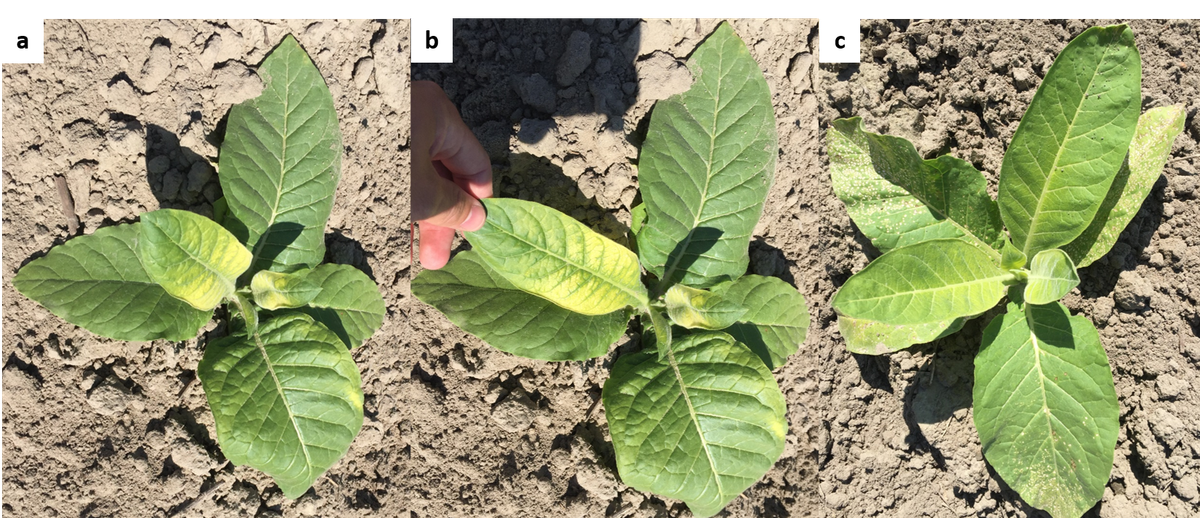
In contrast to frost/freeze damage, we need to also be prepared to monitor young transplants for cold shock. This is the same kind of cold shock (or injury) that we commonly observe in the greenhouse. While it sounds a little odd to raise a warning after transplanting, this is a real scenario that we might face. I've been part of one case like this in my time at NC State, and it was rather surprising to make the diagnosis (Fig. 1a-c). Just as we describe in a greenhouse setting, the visual expression of cold shock is a response to a rapid decline in air temperature over a very short period of time. As I look at my local weather forecast, I see a few days at the end of this week where temperatures may drop by as much as 30°F or more. To add to that, we've had a few consecutive days where temperatures have hovered near (or in excess of) 80°F. Some of the crop could be acclimating to warmer weather, albeit to a very small degree. I don't mean to sound alarmist, but we need to be ready to make a cold shock diagnosis if it happens - particularly as growers may need to make quick management decisions. Overall, the good news is that cold shock is temporary and will clear up on its own as our daily temperatures get warmer. Producers should be reminded that additional fertilizer won't help, nor will any pesticides or plant protection chemicals.