March 8th, 2017
With the continuance of abnormally warm weather, winter annual weeds are out in full force. It is also possible that summer annual or biennials might appear earlier than normal this season. For those fields that have been bedded already, hopefully a preplant-incorporated (PPI) herbicide was applied. There is still a lot of time between now and when plants get in the field, so some protection is helpful to prevent weed growth in freshly tilled soil.
Once transplanting comes, we certainly encourage a pretransplant (PRE-T) herbicide application if a PPI material was not used close to planting time. There are a few options; however, we continue to recommend a tank-mix of Spartan 4F and Command 3ME. With this particular combination, we suggest having beds made and the tops knocked off prior to application. This prevents soil movement as well as the potential for creating “hotspots” in the bed that may injure plants. If for some reason a considerable amount of time has passed between bed formation and transplanting and weeds are visible, an application of Spartan Charge may be useful. This would be used in the same manner, just taking the place of Spartan 4F and also offering some contact control of weeds.
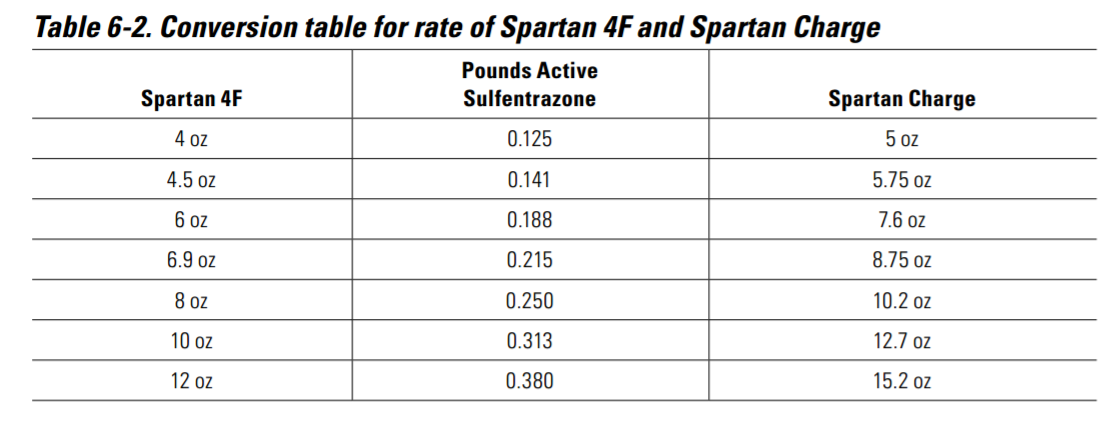
It’s not anything new, but it is important to understand the difference in Spartan 4F and Spartan Charge. Spartan 4F active ingredient (ai) is sulfentrazone and contains 4lbs of this ai. Spartan Charge is a premix of sulfentrazone and carfentrazone (the ai in Aim) which contains 3.15 lbs of sulfentrazone. Sulfentrazone (Spartan 4F) is the ai that provides residual control. The addition of carfentrazone does nothing with respect to residual activity.
However, depending on the difference in price between the two products, a grower may find that it is still cheaper to use an increased rate of Spartan Charge to match that of Spartan 4F. Below is a table from the production guide, showing the rate conversion between Spartan 4F and Spartan Charge.